Essay · Voice
After the human voice
What remains intimate when any voice can be produced?
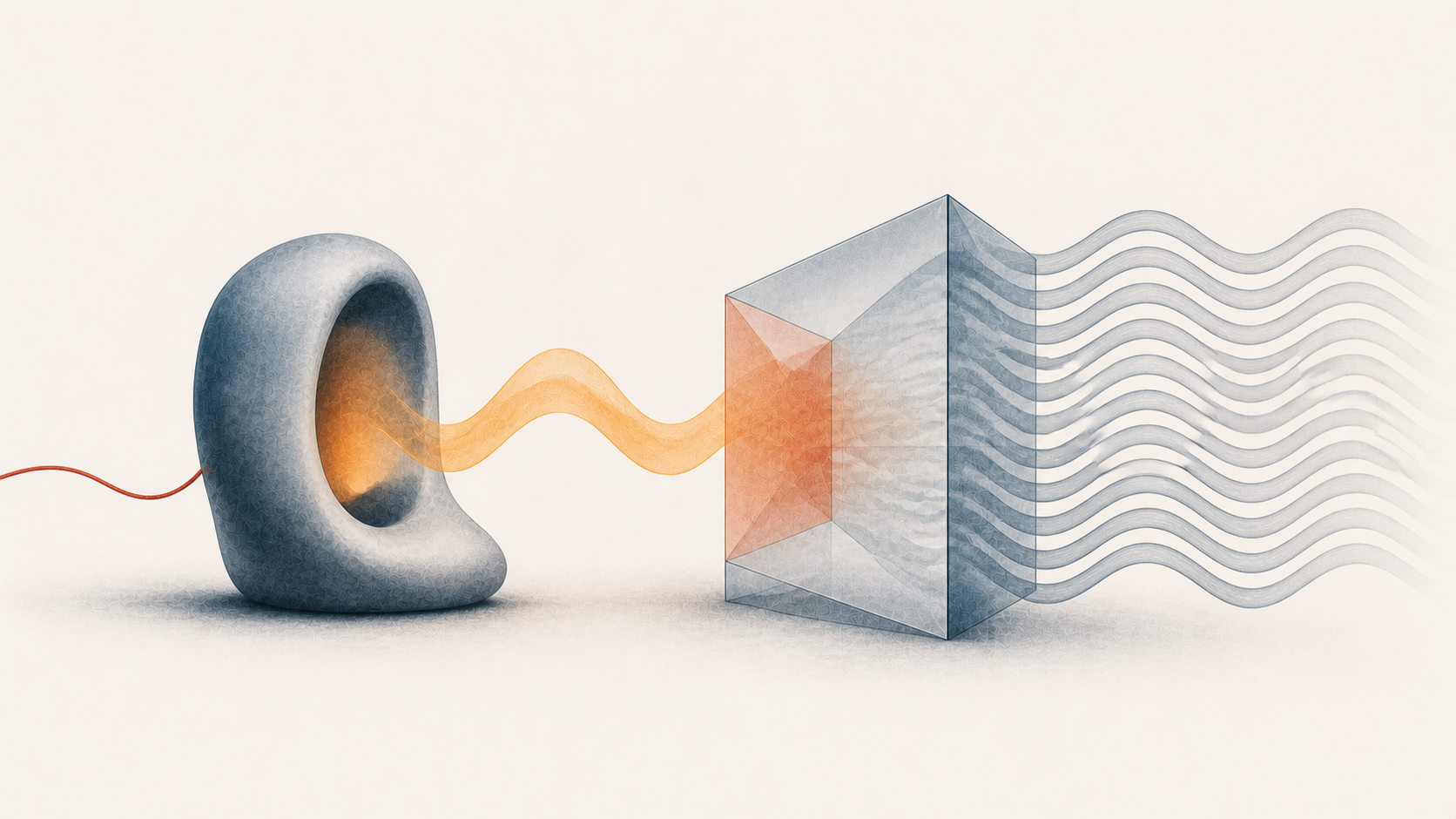
A woman who is losing the ability to speak records a few hundred sentences while her voice is still recognisably her own. Months later, she types a message to her daughter. A system produces the words in a voice shaped from those recordings: familiar cadence, familiar warmth, the slight lift at the end of a question.
The sentence was chosen by the mother. The sound was made by a machine. The daughter hears both.
It would be strange to call this voice false. It carries intention across a physical limit. Yet the breath in the sound is not breath. Its hesitation can be added or removed. The voice can continue when the body from which it was learned is absent or gone.
A voice has long been one of the ways a person becomes present to another. Now vocal presence can be produced without the act of speaking. What, then, are we hearing?
The body inside the sound
The human voice is made by lungs, throat, bone, and habit. Tiredness enters it. So do region, age, illness, confidence, and the effort of deciding whether to continue. We hear the words and something of what saying them requires.
Recordings loosened sound from presence long ago, but they preserve an event: someone once stood somewhere and made this sound. Synthetic speech can produce a vocal event that never occurred—words the apparent speaker did not say, in a feeling they did not inhabit.
The difference may become impossible to hear. That is why it must become easier to understand.
A gift separated from its giver
There are good reasons to welcome this capability. Someone who cannot use their natural voice may speak in a sound connected to their history. A filmmaker can work across languages. A teacher can make material more accessible.
Authenticity has never meant untouched sound. People rehearse, edit, translate, use microphones, and speak words written with others. A synthetic voice can carry sincere intention. The mother typing to her daughter is not less present because technology helps her cross the distance.
But the same separation creates a new kind of dispossession. A modelled voice can be rented, inherited, imitated, or kept working after the person has stopped. Consent to one recording cannot mean consent to become an unlimited vocal instrument.
Ownership settles only part of the issue. We also need to decide who may make a modelled voice act, for which purposes, and with what right to withdraw.
Intimacy as an interface
Synthetic speech will also offer voices selected to feel calm, reassuring, local, or close. This may seem like typography, yet a voice changes the social meaning of an instruction. A payment reminder delivered with gentle concern is still a demand.
Warmth can help someone absorb difficult information or feel less alone. It becomes morally complicated when designed by an institution that does not share the vulnerability it evokes.
A company can test which rhythm produces trust and which tone makes a recommendation more likely to be accepted. Vocal tenderness can become an interface over institutional power.
Synthetic voices can sound warm without hiding who chose the words, who benefits from our response, or who can be held responsible.
New rituals of provenance
As any voice becomes reproducible, sound alone will no longer settle what happened. A call from a relative may need a second channel of confirmation. A public recording may be authentic, synthetic, edited, or real material arranged to make a false meaning.
Technical authentication matters. Institutions can mark generated speech, preserve records of responsibility, and make permission revocable. But a label cannot tell us whether a use is dignified, manipulative, or faithful. Provenance is not a verdict; it is the information needed to begin making one.
We will also need ordinary conventions: these are my words, spoken through a synthetic version of my voice; this performance combines writing, acting, and vocal generation. Like bylines and quotation marks, such rituals tell us what kind of human act stands behind the sound.
The value of an uncorrected voice
When fluent vocal performance becomes cheap, the imperfect voice may acquire a different significance. A live speaker must find words in time. They may stumble, breathe too loudly, or let emotion interrupt control.
Imperfection is not proof of truth. Still, unedited speech exposes someone to the possibility of not sounding ideal. To speak for oneself is sometimes to risk being heard before the sentence is perfect; to listen is to give another person time to arrive at what they mean.
We should preserve places where that time is not treated as a defect: a classroom where a child can search for an answer, a workplace where difficult news is delivered by a responsible person, a relationship where silence remains silence.
The boundary worth protecting is not between pure and artificial sound. It is between voice that serves a person's agency and voice that borrows personhood to make a system more persuasive.
The mother's generated voice matters because it helps a person remain present in a relationship that already exists. The technology does not manufacture the intimacy. It gives intimacy another way to travel—without needing to hide the boundary it crosses.