Essay · Human value
AI is changing. What about us?
The space between is where our future is being made.
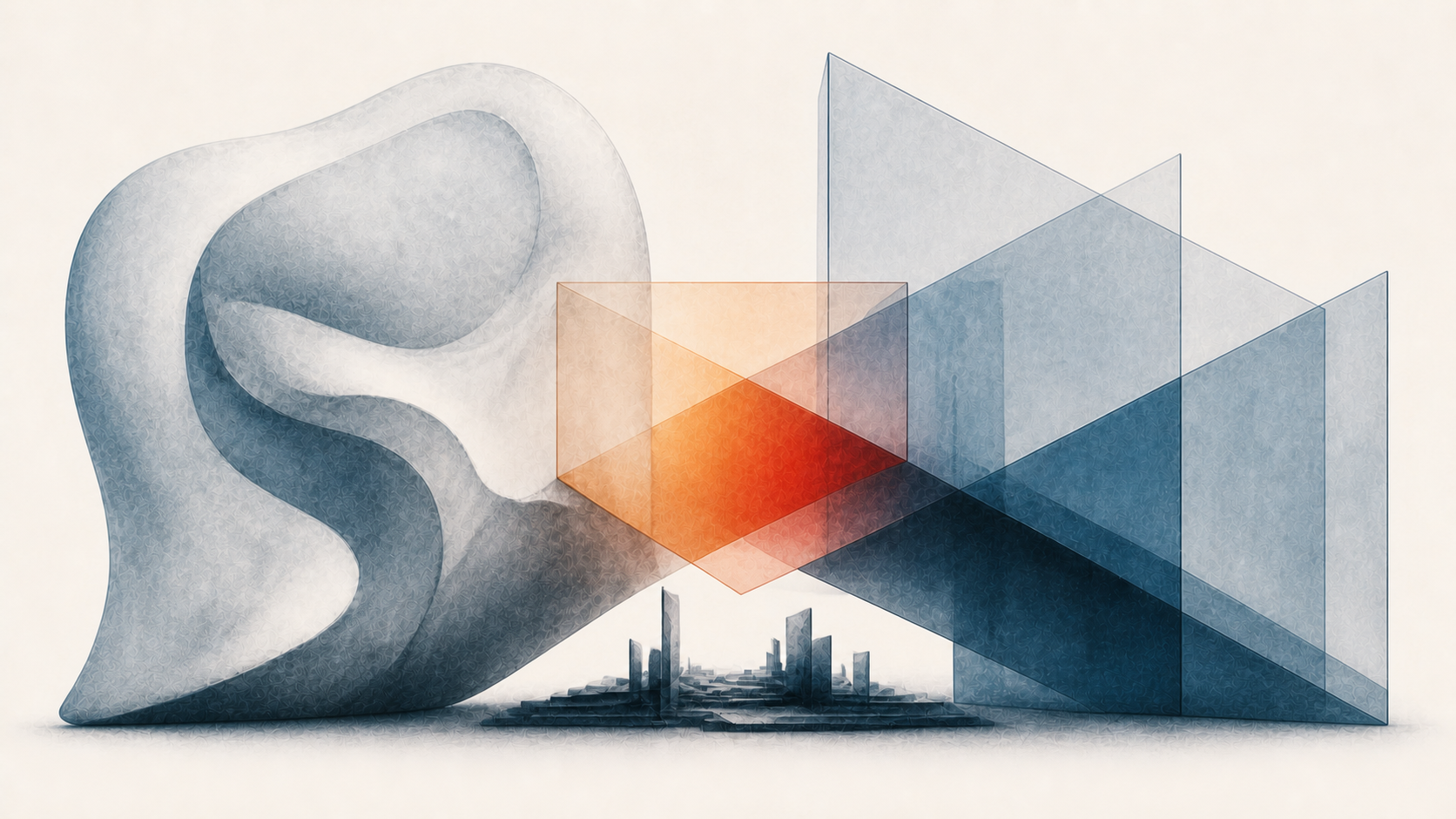
Artificial intelligence is usually introduced through a spectacle of capability. A machine writes, speaks, draws, diagnoses, predicts, and plans. Each demonstration invites the same question: how far can it go?
That question matters. It is not, however, the only place where change occurs.
The deeper transformation begins when a system enters someone’s day. An answer changes a decision, a recommendation becomes a habit, an institution reorganises work around a prediction, or a person begins to understand themselves through the categories a machine returns.
AI does not need to become human to change what being human feels like.
The wrong distance
We are encouraged to imagine two separate figures. On one side stands humanity: embodied, emotional, fallible, carrying memory and responsibility. On the other stands artificial intelligence: computational, scalable, designed, and increasingly capable.
From this distance, the debate becomes a contest. Which tasks belong to whom? Will machines surpass us? What remains uniquely human?
But people and technologies never remain on opposite sides of a clean line. We build tools, and then rebuild our practices around what those tools make easy. Writing changed memory. Photography changed evidence. Search engines changed how we look for and remember facts.
The boundary matters, but so does everything crossing it.
What enters the space
When a person meets an AI system, they do not meet a model alone. The encounter contains an interface that determines what can be asked, a company deciding what may be measured, data carrying the patterns of earlier lives, and an institution choosing where the answer will be trusted.
The person also brings more than a prompt. They bring uncertainty, intention, vulnerability, and a situation the system cannot inhabit. The words may pass in both directions, but their meaning does not belong equally to both sides.
This asymmetry is easy to overlook because language creates the sensation of meeting. A fluent answer feels close. A response shaped to our vocabulary can feel personal. Yet the apparent intimacy may rest on systems and incentives that remain invisible.
The encounter is designed territory.
We become around our tools
The central risk is not simply that machines will make decisions. It is that people may gradually lose sight of where decisions are being shaped.
A suggested sentence changes the effort required to express an original thought. A predicted risk changes how an institution sees a person before meeting them. A companion that is endlessly patient changes what ordinary human attention feels like by comparison. None of these effects requires coercion. The environment changes, and behaviour follows.
The familiar division between “human choice” and “machine output” is therefore insufficient. Choice takes place inside conditions. AI participates in arranging those conditions: what appears first, what feels normal, what is legible, and what requires resistance.
We remain responsible, but responsibility now extends to the architecture surrounding the moment of choice.
Neither surrender nor purity
One response is surrender. The technology is inevitable, so adaptation becomes the only serious position. Another response is purity: protect the human by keeping the machine at a distance.
Neither is adequate.
Surrender disguises decisions as destiny. Every system contains judgements about efficiency, acceptable error, whose language is represented, and which consequences count. Purity ignores how deeply human life has always been formed through tools, institutions, and other minds.
Untouched humanity has never existed. What we can shape is the relationship: intelligent machines can enlarge human agency instead of reorganising it around the needs of systems.
A visible boundary
A workable relationship with AI depends on a visible boundary.
People should know when an intelligence is synthetic, when a decision depends on prediction, when uncertainty is significant, and when commercial incentives influence the encounter. They need meaningful ways to question an output, refuse a recommendation, leave a system, and reach a responsible person.
Friction is not always failure. A pause can protect judgement. An explanation can return agency. A limit can preserve the difference between assistance and authority.
Good design does not merely make AI easier to use. It makes the relationship easier to understand.
What about us?
Technological change is also moral, cultural, and psychological change. The questions that follow concern what it is doing to human life now.
What forms of attention are we practising? What kinds of dependence are we building? Which decisions are becoming invisible? Who controls the systems through which more of life is interpreted? What capacities grow when machines assist us, and which ones weaken when assistance becomes the default?
Artificial intelligence will continue to change. Its capabilities will improve, its presence will become ordinary, and many of today’s astonishments will disappear into infrastructure.
What happens to us is less automatic.
That future is being made now, in the space between what machines can do and what people decide their capabilities should mean.