Essay · Intimacy
Care without witnesses
What can monitoring know when no one enters the room?
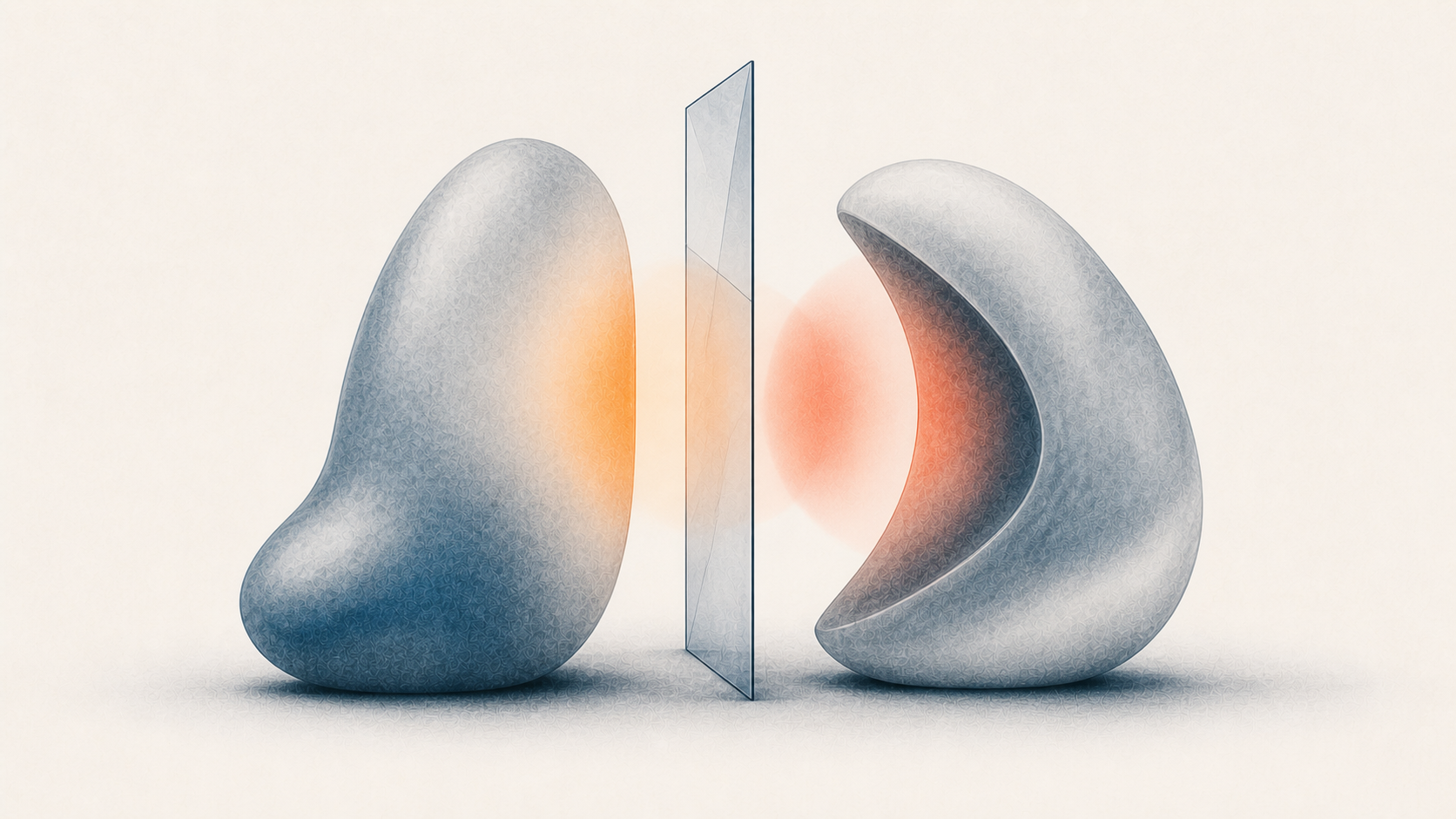
An older woman lives alone in a flat equipped with quiet forms of attention.
A sensor records when she leaves the bedroom. A watch notices changes in her movement and heart rate. A speaker reminds her about tablets and asks whether she has eaten. Her daughter can open an app before work and see a row of green circles: awake, medication taken, kitchen visited, no fall detected.
The circles bring relief. They allow the daughter to begin her day without making a worried telephone call every morning. They let her mother remain at home without feeling that someone must continually check on her. If the ordinary pattern changes sharply, a person can be alerted.
One week, the pattern stays ordinary. What the system does not record is that the woman has stopped going downstairs at lunchtime. A friend from the building has died, and the empty chair in the lobby has made the usual gathering difficult to bear. She eats upstairs instead. She sleeps, walks, and takes her tablets within the expected range.
The dashboard remains green.
Nothing here proves that monitoring has failed. The system was built to notice particular forms of danger, and those dangers matter. It may know that a life is continuing according to its measures. It cannot establish whether someone has encountered that life closely enough to understand how it is being lived.
This is the tension inside care assisted by AI. A person can become extensively known through signals while passing through their days without a witness.
A body translated into signals
Care has always involved observation. A nurse notices breathing, colour, appetite, balance, and pain. A relative sees that the post is unopened or that the same story returns three times. Good care depends partly on detecting change.
Digital systems extend this vigilance beyond the moments when another person is present. They can compare movement across weeks, listen for distress, organise medication, identify a broken routine, and draw attention to a change too gradual for a hurried visitor to see. They do not become bored by repetition or assume that today resembles yesterday.
To work, the system must translate a life into features it can register. Sleep becomes duration and interruption. Eating becomes a visit to the kitchen or the opening of a fridge. Social contact becomes speech, proximity, or the use of a device. Distress becomes a deviation from a baseline.
These translations can be useful without being complete. A late rise may indicate illness, a sleepless night, a good book, or a refusal to keep someone else’s preferred timetable. The system sees a difference before it knows what the difference means.
Meaning enters through interpretation. Someone has to decide which changes deserve attention, what counts as normal, and when an alert should alter another person’s day. Those decisions are made by designers, care providers, families, clinicians, and public authorities, often long before the person being monitored feels their effect.
The readings may be intimate. The categories around them belong to an institution.
What vigilance can give
It would be easy to romanticise the unrecorded home. Many people living alone are already seen too rarely. Relatives may be far away. Care workers may have minutes where an hour is needed. A change in gait or sleep can pass unnoticed until a crisis makes it undeniable.
Continuous monitoring can create room for freedom. A person at risk of falling may keep living in familiar surroundings. Someone with a fluctuating condition may receive help in response to need rather than according to a fixed timetable. A care worker can arrive knowing that appetite or movement has changed and use the visit to ask better questions.
Privacy itself can sometimes improve. A discreet sensor may feel less intrusive than frequent checks by strangers. A person may prefer a machine to notice that they have used the bathroom rather than explain the same fact repeatedly. Families can share responsibility without demanding constant reassurance from the person they love.
Human presence is no guarantee of good care. People can be impatient, careless, patronising, or cruel. They miss patterns, bring assumptions, and sometimes make independence harder by treating every risk as a reason for control. A well-designed system can notice without scolding and offer assistance without displaying fatigue.
The relevant choice is rarely between warm human attention and cold machinery. More often it is between different mixtures of visits, devices, professional judgement, family concern, money, and time. The question is what the technology allows those arrangements to become.
Monitoring supports care when it makes a need easier to reach. It diminishes care when the existence of data becomes a reason for people to withdraw.
The life between the readings
A witness sees more than an event. They receive some part of its meaning and allow it to make a claim on them.
When a friend notices that lunch downstairs has stopped, the absence belongs to a shared history: who usually sits where, which stories have been told too often, whose death has changed the room. The observation is inseparable from a relationship. It can be mistaken, but it can also be answered. The woman may say that she wants company, that she wants privacy, or that grief needs another week before she can bear the lobby.
An alert has a different structure. It identifies a condition and sends it towards a response. Even a highly personal system remains dependent on what can be inferred from the signals available. It may detect loneliness through reduced speech, unusual sleep, or repeated attempts at conversation. It cannot decide what kind of presence the loneliness asks for.
This boundary matters because care includes recognition. To be cared for is sometimes to be fed, reminded, lifted, protected, or treated. It is also to have another person learn that this loss matters to you, that this routine carries dignity, or that your silence today differs from your silence yesterday.
Recognition cannot be measured solely by how accurately a system predicts need. It involves exposure on both sides. The witness spends time, risks misunderstanding, and becomes answerable for what they have seen. The person receiving care can resist the account, surprise its author, or ask something that was absent from the original task.
Data may bring a life into view. Witness begins when someone remains long enough for the person inside the data to change the account.
When independence becomes withdrawal
The word independence carries unusual power in care. Most people want control over their home, routines, body, and company. Technologies that make this possible deserve serious support.
Yet independence can be defined by the institution providing it. A service may call a person independent when fewer paid visits are required. A family may call an arrangement independent because worry has been transferred to a dashboard. A provider may describe continuous monitoring as added care while reducing the hours in which a worker can notice anything the sensors were not designed to collect.
The person at the centre may experience the same arrangement as freedom, surveillance, abandonment, or some mixture that changes from day to day.
Who benefits from the saved visit therefore matters. If monitoring removes needless checks and gives care workers more time for difficult conversations, the system can enlarge the human part of care. If it becomes evidence that green indicators are enough, efficiency has converted an absence into a service.
This pressure will not be distributed evenly. People with money may buy both monitoring and companionship. Those relying on stretched public systems may receive remote vigilance as the complete offer. A family able to visit often can treat an alert as useful information. Another person may have no one whose day will change when the alert arrives.
Someone must also watch the watchers. Intimate data about sleep, movement, speech, medication, and visitors can support care while exposing a person to control. Who may see it? Which inference is allowed? Can the person turn the system off without losing the wider service? Does a risk score follow them into insurance, housing, or an assessment of whether they may remain at home?
A promise of safety does not erase the need for consent. Nor should consent be reduced to accepting terms at the moment when refusing technology feels equivalent to refusing care.
Monitoring that returns us to one another
A humane monitoring system would have a modest account of what it knows. It could say that movement changed without pretending to know why. It could preserve a person’s right to periods of unobserved life and collect only the detail needed for the purpose they accepted. Important inferences would expire, and the person being watched could see who had access to them.
The strongest design question comes after detection: what human response does this signal make possible?
An alert can begin a conversation rather than complete an assessment. A pattern can help a care worker prepare while leaving them free to believe the person over the profile. Services can measure whether monitoring leads to timely visits, longer useful contact, and needs being resolved, instead of counting alerts as care delivered.
Some changes should prompt a knock on the door. Others should prompt a question whose answer may be no. The right to be cared for includes room to refuse company, choose risk, keep a secret, and live outside the smoothest version of one’s own safety. Witness differs from surveillance partly because a witness recognises another person’s authority over the meaning of their life.
This requires staffing, time, and relationships that survive beyond one notification. Technology cannot supply those conditions. Institutions decide whether to fund them, families decide how responsibility is shared, and communities decide whether living alone must also mean being cared for alone.
The daughter looking at the green dashboard has received useful information. Her mother is moving through the flat, taking the tablets, making tea. The system has reduced one kind of uncertainty.
It leaves another question for the people around her: who knows what this week has felt like?
The answer need not always be a professional visit or a daily family call. Care has many forms, and constant human attention can become its own kind of intrusion. What matters is that observation remains connected to people capable of entering the room, hearing what the signals could not contain, and allowing what they learn to change what happens next.
No one should have to suffer unseen for technology to count as useful. Neither should a life be mistaken for fully seen because every measurable part of it has been observed.