Essay · Creativity
Creativity after abundance
What deserves to exist when almost anything can be made?
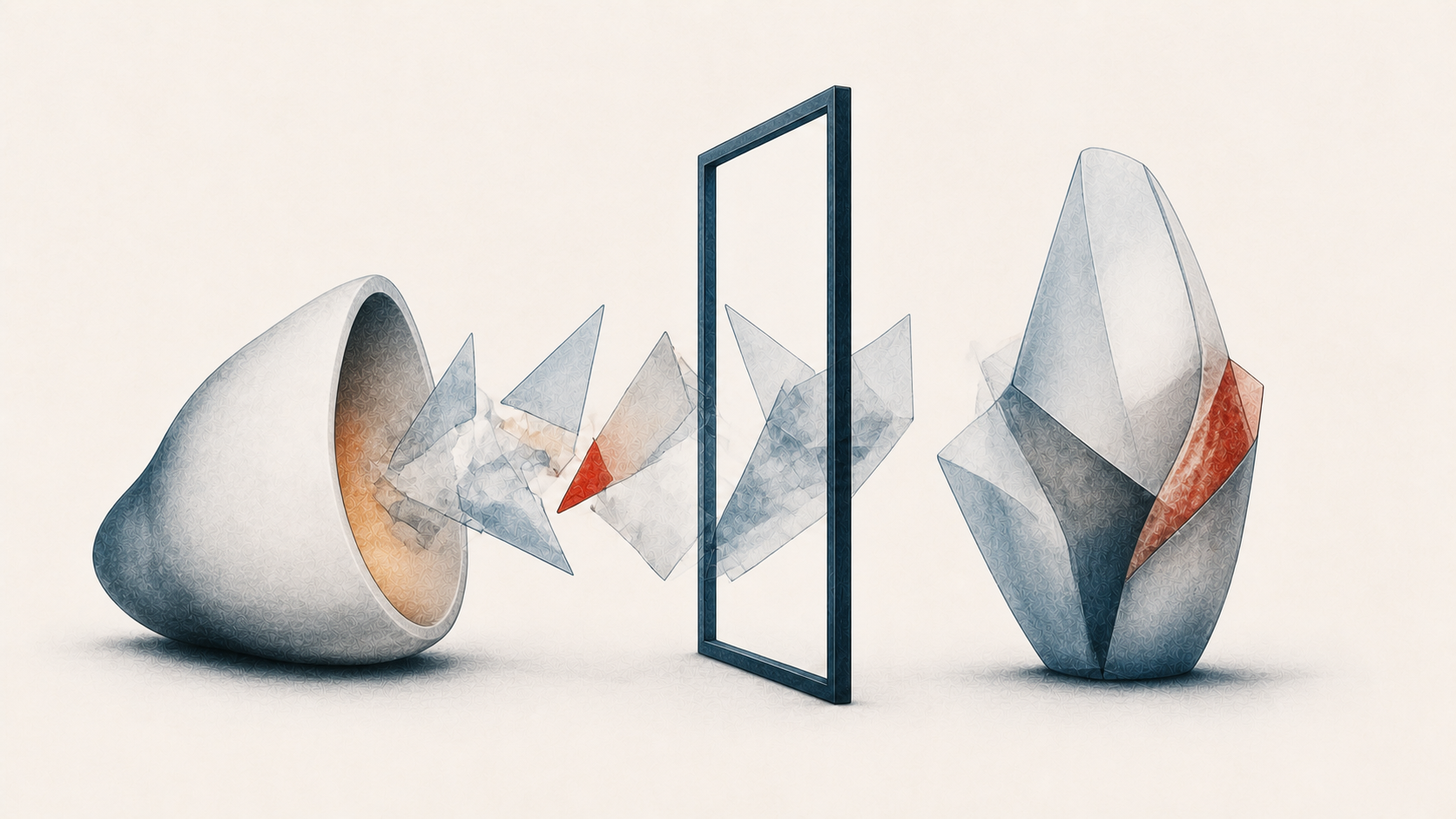
A designer is making a poster for a neighbourhood concert. She begins with a few words about the evening: late summer, a small room, music that should feel close rather than grand. She gives them to an image generator and watches four possible posters appear.
One has the warm colour she imagined. Another finds a stranger, more interesting composition. She asks for variations. Four become sixteen, then forty. Within half an hour she has more competent possibilities than she could have drawn in a week.
None is quite wrong. That is the problem.
She can continue until something astonishing appears, though each new set weakens her memory of what she first wanted. The screen fills with unopened futures. Her work has changed before the poster is finished: she is producing less and choosing more.
Generative AI is often discussed as a new means of creation. It is also a machine for making alternatives abundant. Images, melodies, paragraphs, voices, and layouts can arrive in quantities once reserved for large studios, and sometimes in quantities no studio would have asked people to make.
This abundance can release ideas that money, training, disability, or time once kept out of reach. It can also leave us with a harder question than how to make something: which possibility deserves our commitment?
When another version costs almost nothing
Creative work has always taken place among limits. A roll of film ended. Paint had to dry. Studio time was expensive. A sentence could be revised repeatedly, but each revision still required the writer to live inside it for a while.
Those limits were never sacred. Many kept people out. Cheap cameras, accessible software, sampling, and self-publishing enlarged culture by letting more people make and share work. Generative tools may continue that opening. Someone can test a visual idea without mastering illustration, hear an arrangement before hiring musicians, or find a form for an experience they could not otherwise express.
Yet effort did more than ration access. It created contact between an intention and its consequences. The line on the page answered back. A melody that seemed moving in the mind became sentimental when played. By making one thing, the maker learned what the idea required and where it resisted them.
When another version costs almost nothing, the encounter can be postponed. Instead of staying with the difficult line, we request a fresh page. Instead of deciding why an image fails, we replace it with four more. The supply of alternatives protects the original intention from being tested.
Possibility is exhilarating at first. After a point, it becomes a way of avoiding the moment when a preference has to become a decision.
Taste cannot remain a reaction
Abundance makes taste look like the central creative skill. If a system can produce many plausible works, perhaps the human role is to select the best one.
Selection matters, but taste is not a private sensor that simply detects quality. It is formed through attention, practice, argument, inheritance, and failure. We learn to prefer certain rhythms because we have felt what they do across a whole work. We recognise a false note partly because we have made one and had to understand why it failed.
A person presented with polished options can choose without possessing this history. They may select the image that feels most finished, the sentence that sounds most assured, or the song closest to something already loved. The choice can be sincere and still be guided by the surface conventions the system reproduces most fluently.
Generative tools can educate taste too. They allow comparison. A filmmaker can test how a scene changes under another rhythm; a writer can expose a paragraph to an opposing voice. Used with attention, variation makes hidden decisions visible.
The crucial movement is from reaction to account. Why this version? What does it allow the work to say? What has its polish concealed? A maker does not need to explain every intuition, and analysis can drain life from a choice. Still, a practice of taste grows when preference meets consequence. “I like this” becomes “this belongs here”—a judgement that can survive the arrival of another attractive option.
Every finished work contains a refusal
To make one thing is to abandon others. The abandoned poem may contain a better phrase. The discarded sketch may have more energy. A finished work carries the knowledge that another version was possible and was refused.
This refusal is part of its form. A story gains meaning because it follows these lives and leaves other lives outside the frame. A song ends because continuing would change what came before. Commitment gives the work edges.
Systems built around generation tend to keep those edges open. There is always another variation, another level of polish, another attempt at the part that feels uncertain. The tool is doing what we ask, and the service has little reason to tell us that enough has been made.
Endless revision can resemble devotion to quality. It may instead keep the maker in a state where no decision becomes binding. The work remains full of potential because it never has to enter the world and meet another person's attention.
Stopping is therefore a creative act. It says that this imperfect arrangement, among all the available arrangements, is the one for which the maker will answer. The decision may later prove wrong. Responsibility begins before certainty.
The surplus arrives somewhere
An unlimited supply of drafts does not create an unlimited audience. Every generated proposal eventually reaches someone who must read, view, rank, approve, store, or ignore it.
Inside organisations, this can shift labour rather than remove it. One person produces a hundred naming options in minutes; a team spends an afternoon reviewing them. A student submits pages no teacher could have assigned a human being to write in the available time. A company fills its channels with tailored material, leaving customers to decide which messages deserve belief.
The producer experiences abundance as freedom. The receiver often experiences it as volume.
This changes the ethics of making. “It was easy to generate” tells us nothing about whether it is worth another person's time. When the cost of production collapses, creators and institutions can pass the cost of selection downstream. The scarce material is no longer the draft. It is the attention required to discover whether the draft contains anything that matters.
Platforms already decide which part of the surplus becomes visible. Their rankings can reward familiarity, frequency, and whatever holds attention long enough to be measured. If generated culture expands while the routes to an audience remain concentrated, apparent creative plenty may deepen the power of the systems that sort it.
More people should be able to make. That gain becomes thinner if everyone must produce continuously to remain findable, or if public culture is crowded with material no one felt responsible for finishing. Access to production needs to be joined by institutions willing to value editing, attribution, patient criticism, and work that does not arrive at platform speed.
A practice of enough
Creativity after abundance may require rituals that place a limit where the tool no longer supplies one.
A maker can begin by naming what the work is trying to hold before generating alternatives. They can choose a small number to examine closely, rather than treating every result as a doorway to more. They can return to the material by hand, keep the awkward element that gives it character, or ask another person what they notice before asking the system for another solution.
There is value in deleting the unused versions. Not because storage is scarce, but because a private archive of infinite alternatives can keep every decision provisional. Letting versions go allows the chosen work to become more than the current winner of a contest that never ends.
Institutions need their own limits. They can set standards for how much generated material they ask others to review, make responsibility for the final work visible, and reward people who reduce a field of options with care. A newsroom, studio, school, or company should be able to say who chose this, why it was released, and what human attention its production assumed.
The designer returns to the concert poster. Among the forty images, she chooses one of the earliest. Its lettering needs work, and one shape is less graceful than in a later version. But the room in it feels small enough. It invites people towards one another instead of promising a spectacle the evening cannot provide.
She changes the type, removes a decorative flourish, and sends the poster to print. Another prompt might have produced something stronger. It would certainly have produced something else.
The point of her decision is not that she defeated the machine in a contest of originality. She decided what the concert should promise, accepted what the choice excluded, and stopped generating when the work could bear that intention.
When almost anything can be made, creativity does not disappear into abundance. It gathers around commitment: the care to choose, the courage to refuse another version, and the responsibility of placing one thing rather than forty into the limited space of another person's world.