Essay · Attention
The muscle of attention
What we notice becomes part of who we are.
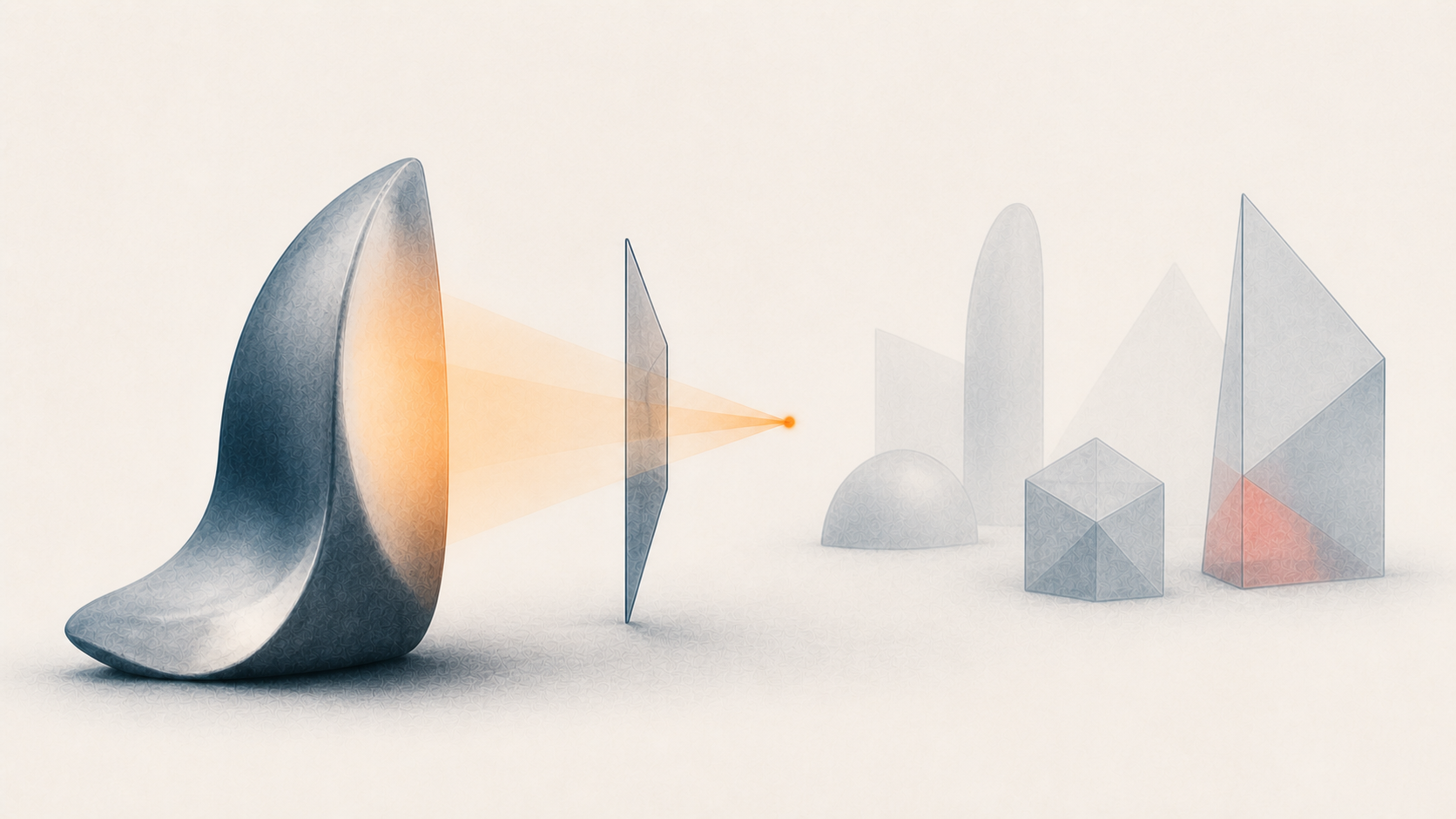
A man sits beside his father in a hospital room. There is no new information. The machines continue their quiet measurements; the light moves slowly across the floor. His phone offers a summary of the messages he has missed and a sequence of things selected to hold him for the next few minutes.
He looks because there is nothing he can do. When he looks up again, his father has opened his eyes.
No catastrophe has occurred. The moment is still there. Yet the small interruption reveals something easy to miss: attention is not only a beam we point at whatever matters. It is one of the ways mattering comes into being.
Artificial intelligence promises to help us direct this scarce resource. It can separate signal from noise, identify the important passage, condense the meeting, and bring forward what we are likely to need. In a world that demands more notice than any person can give, such help is not trivial. It can be a form of rescue.
But when systems become increasingly skilled at deciding what deserves our attention, we should ask what happens to the capacity by which we decide for ourselves.
Attention is something we practise
We often speak of attention as if each person receives a fixed daily supply. Spend it on one thing and less remains for another. This is partly true. Fatigue, stress, illness, and care all change what can be given.
Attention, however, is also formed through use. The reader who stays with a difficult page becomes able to notice an argument unfolding slowly. The nurse learns to hear a change in breathing beneath the general noise of a ward. A child looking into a tide pool begins with "nothing" and, through patient looking, discovers a crowded world.
These are not merely acts of concentration. They are educations in significance. To attend is to learn what differences matter, what can be ignored, and when the ordinary deserves another look.
The opposite is true as well. Capacities that are rarely exercised become harder to call upon. If every pause is filled, waiting becomes intolerable. If every document arrives with its important points extracted, the unmarked sentence becomes easier to pass over. If every question is met immediately, the quiet interval in which a better question might form begins to feel like system failure.
The concern is not that machines distract us while human beings would otherwise live in perfect concentration. Minds wander. Books, conversations, cities, and other people have always competed for notice. The change lies in the scale and precision with which attention can now be anticipated, arranged, and returned to us as a service.
When relevance arrives too early
Much of AI's value comes from relevance. A system can search a thousand pages and find the paragraph connected to our problem. It can notice a medical anomaly hidden among routine measurements or make an overwhelming interface usable for someone who needs assistance.
Relevance protects people from needless cognitive labour. It can also close a question before we know what the question contains.
Curiosity often begins with an interval of uncertain notice: something does not fit, but we cannot yet say why. We reread a sentence, follow an unfamiliar reference, or remain with an observation that has no immediate use. The path appears wasteful because its value is not available at the beginning.
A system trained to infer our purpose may remove that interval. It gives the likely explanation, highlights the probable answer, and offers the next sensible question. The assistance can be excellent and still narrow the encounter. We receive what is relevant to the intention we already had, while the material loses its chance to alter that intention.
This is a subtle form of dependence. We may retain the ability to examine the source while losing the habit of discovering why we should. The machine does not forbid curiosity. It reaches the scene before curiosity and furnishes it.
The institutions behind the highlight
No system decides significance in the abstract. It decides in relation to a goal.
In a workplace, the important message may be the one most likely to require action. In a school, it may be the passage most likely to appear in an assessment. In a news service, it may be the item most likely to keep a reader engaged. These purposes are not always hidden or malign. They are simply incomplete.
What matters to an institution and what matters in a life sometimes overlap. Sometimes they do not. A productivity system can notice a delayed task but not the colleague who needs an unhurried conversation. A learning platform can notice the wrong answer but not the unusual idea beside it. A care system can flag a measurable deterioration while missing that a person has stopped talking about home.
The more capable the selection, the easier it is to experience the institution's priority as our own perception. We see what has been surfaced and feel that we have seen the situation.
This gives the design of attention a political dimension. Who defines urgency? Which forms of significance can enter the model? Who benefits when a person moves quickly from notification to action? The interface may feel personal, but the hierarchy of notice can carry the values of an employer, platform, school, or state.
Attention is scarce for institutions too. Automated selection can help them respond to people otherwise lost in volume. Yet when only what can be detected receives care, measurement becomes a gate through which a need must pass before it can matter.
The privilege of being able to look away
Advice about attention is often personal: silence the phone, close the browser, cultivate a deeper mind. These practices can help. They can also disguise how unevenly distraction and vigilance are distributed.
A delivery worker cannot ignore the system that assigns the next task. A parent waiting for news from a doctor cannot treat every alert with serene indifference. Someone whose housing, immigration status, or benefits depend on an online account has reasons to remain reachable. For many people, fractured attention is not a failure of discipline but a reasonable response to conditions they did not choose.
The freedom to attend deeply depends on time, security, space, and some confidence that looking away will not carry a penalty. Institutions that consume attention cannot place the entire burden of recovery on individuals.
They can make urgency truthful rather than habitual. They can limit interruption instead of testing which interruption works. They can protect periods in which workers and students are not expected to respond, and preserve human routes for needs that do not fit the system's signals.
A humane attention policy would ask whether information reaches people and what kind of attentiveness the method requires them to practise all day.
Keeping the first look
We do not need to meet every object without assistance. There is no virtue in reading all thousand pages when the needed fact is on page nine hundred. The purpose of protecting attention is not to make life laborious. It is to preserve some authority over the movement from not knowing to knowing.
That may mean taking a first look before requesting a summary, allowing a question to remain unanswered for a little longer, or asking a system to show what it omitted and why. An assistant can offer several accounts of relevance rather than a single ranked path. It can distinguish what is urgent from what is merely engaging, and leave room for a person to set a purpose the system cannot infer from prior behaviour.
The deeper work is collective. Schools can treat sustained, unaided attention as a capacity worth forming rather than an inefficiency to eliminate. Workplaces can value the noticing that occurs outside dashboards. Designers can measure whether a tool returns attention to a person's world, not only whether it captures another minute.
The man in the hospital room cannot attend without interruption forever. No one can. His phone may bring a message he genuinely needs, and the machines beside the bed are themselves instruments of vigilant care.
The distinction is not between pure human presence and technological distraction. It is between tools that help us give attention where we have decided it belongs and systems that continually decide belonging on our behalf.
What we practise noticing becomes part of the world available to us. It also becomes part of the person available to others. The muscle of attention is not strengthened by refusing every aid. It is strengthened when assistance leaves us more able to look again—and to recognise, sometimes before any system does, what the moment is asking from us.