Essay · Identity
The self that fits the profile
Who are we allowed to become when prediction prefers continuity?
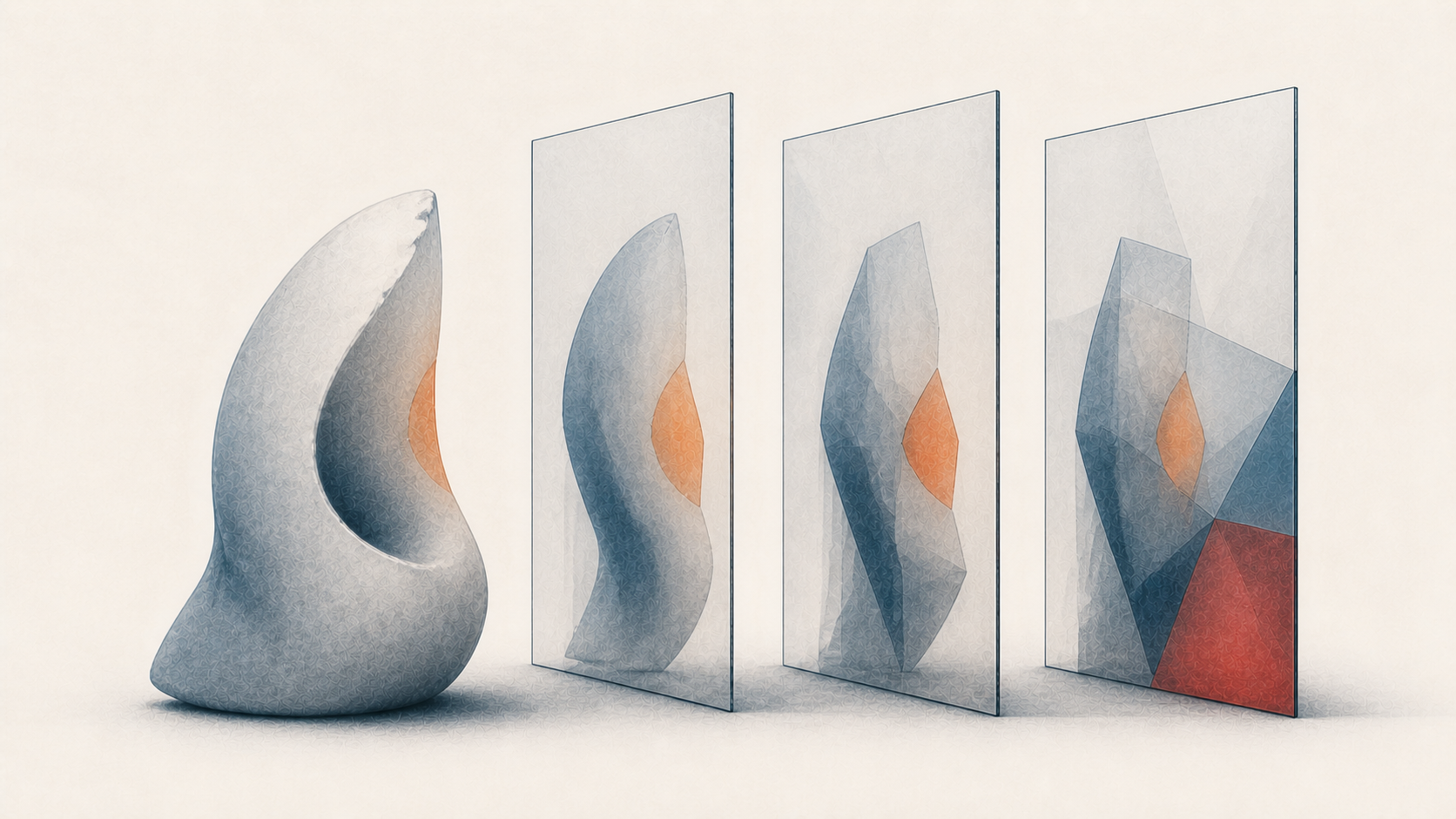
At forty-two, a hotel manager decides she wants to become a landscape gardener.
She has spent years organising rotas, calming tired guests, and noticing what a room needs before anyone asks. These abilities are real, but the recruitment service sees hospitality, operations, customer retention. It offers senior hotel roles, then more of them. A training platform recommends courses that deepen the career she is trying to leave.
Nothing prevents her from typing a different word into the search box. Yet the world prepared for her keeps returning the person she has already been.
A profile begins as a practical reduction: a way to estimate what someone might want, need, buy, risk, or do next. It is not the person. But once it arranges opportunities, prices, and attention, the probable self becomes the easiest self to continue being.
A machine-generated profile can shape a life without discovering anyone’s true identity. An identity created for prediction can become one we are invited, rewarded, or required to inhabit.
The usefulness of a smaller person
Institutions have always made people smaller in order to act at scale. A school records attainment. A bank records income. A hospital records symptoms and risk. Categories can expose unfairness, distribute resources consistently, and protect people from arbitrary judgement.
Reduction is unavoidable; no institution can hold the whole person. Trouble begins when an institution forgets why the reduction was made.
A credit category may estimate one kind of financial risk; it does not measure reliability as a neighbour. Late assignments may help a teacher notice a student who needs support; they do not reveal whether the student is careless, caring for a parent, or becoming absorbed in something the timetable cannot recognise.
Profiles become dangerous when these boundaries dissolve. A temporary difficulty becomes a durable trait. A probability becomes a character judgement. The smaller person was created to make a system manageable, and soon the living person is asked to become manageable too.
When the description returns
A prediction does not remain where it was calculated. It returns as an environment.
A student judged unlikely to finish may receive fewer demanding opportunities. A worker judged likely to leave may be passed over for development, making departure more likely. A teenager who once settled on anxious material may receive an increasingly anxious account of the world.
The profile helps produce evidence of its own accuracy. People still refuse recommendations and act against type, but surprise has a cost. The expected path is visible and prepared; the unexpected one must often be found without institutional help.
That cost is unequal. A well-connected person can explain the unusual year, pay for another assessment, or reach someone with discretion. Someone with less power may meet the profile as a closed surface, with no audience for an explanation because no one is officially making the decision.
The comfort of being told who we are
Not every profile is imposed. Many are offered as a service: what kind of reader, learner, leader, or partner are you? The account can be comforting. People have always found themselves through descriptions made by others.
A machine-generated profile makes the interpretation continuous. It follows our behaviour, revises itself silently, and places its conclusions directly into the next choice. We do not only read the description; we receive a world tailored to it.
Behavioural data is conservative. It records what we did under the conditions that existed. It cannot contain the friendship we have not formed, the skill we have not attempted, or the conviction that will arrive after an experience still ahead.
We may collaborate with the profile because coherence is easier than contradiction. We click what confirms a taste and present the skills platforms already recognise. The available repetitions are increasingly selected by systems whose purposes remain elsewhere. That can make a real self feel more complete than it is.
A right to outlive the evidence
Human freedom includes the possibility of becoming someone for whom the old options no longer fit.
We are not infinitely open, and institutions still need to identify risk. But uncertainty about a person is not merely a technical defect awaiting better data. Some uncertainty belongs to the fact that a life is unfinished. A profile can estimate continuity; it cannot own the meaning of a departure from it.
A humane system would treat categories as provisional tools rather than identities. It would show what shaped an important judgement, allow inferences to expire, keep contexts separate, and provide an appeal capable of changing the outcome.
It would also measure more than predictive accuracy. A system can become accurate by narrowing the futures available to the people it predicts. We should ask whether people can move between categories and whether unusual cases can still reach responsible human judgement.
The aspiring gardener may discover that the work is not what she imagined. A humane system need not promise that every reinvention succeeds. It should make room for the attempt to become evidence of its own.
Prediction helps us navigate what is likely. It becomes authority when the likely decides what is possible. The freedom at stake is the freedom to outgrow a description, contradict a record, and arrive in a future for which our past supplied no proof.