Essay · Work
The work left to humans
Who decides which parts of a job still deserve a person?
On Monday morning, a customer adviser opens a new queue. The straightforward requests have already been answered. Addresses were changed, balances explained, replacement cards ordered. The system handled them overnight with speed and consistent politeness.
What remains are the conversations it could not settle: a payment made by someone who has died; a traveller whose documents do not match; a woman trying to describe why a transaction that looks ordinary is dangerous for her. Each person has already passed through the automated route. Some are frustrated. Several must tell the story again.
The adviser has been told that automation will free her for more meaningful work. In one sense, it has. The people in her queue need interpretation, patience, and discretion. They may need another human being to recognise that the available categories do not contain their situation.
But her working day has also changed its emotional weather. The easy exchanges that once gave rhythm to the shift are gone. Every case now carries difficulty. Targets still count calls, and the team is smaller because the system was expected to increase capacity. She has been left with the human work and less room in which to do it.
This is one version of a future often described with confidence: machines will take the routine tasks, while people move towards judgement, creativity, care, and connection. The promise is attractive because those words name activities many of us want work to contain. Yet it leaves an important decision unexamined. Who will decide what work remains, under what conditions, and how its value will be recognised?
The shrinking remainder
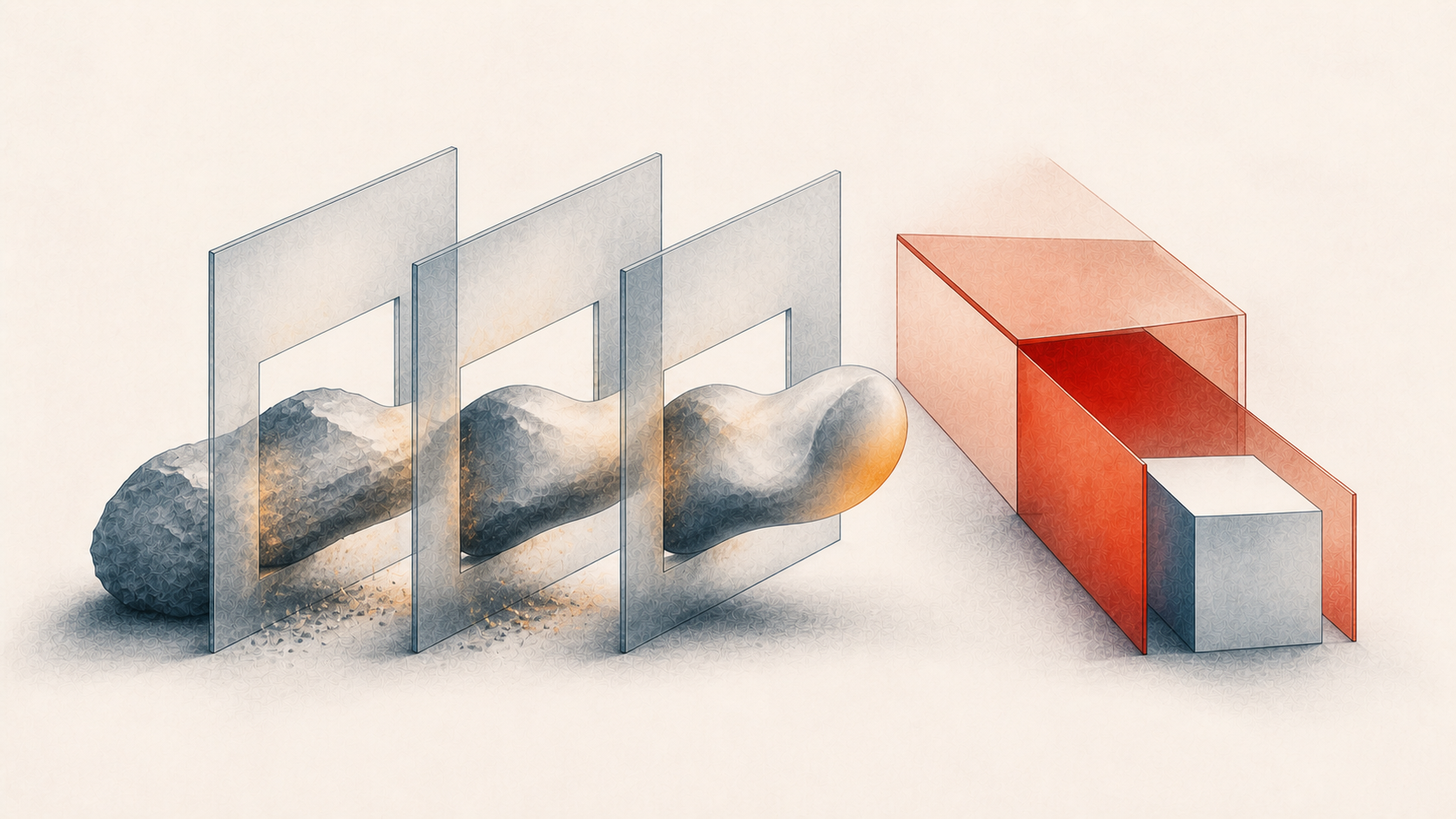
If human work is defined as whatever machines cannot yet perform, its meaning changes whenever a capability improves. Today we supervise the system; tomorrow the system supervises more of the process and asks us to confirm its exceptions. The boundary moves, while people learn to describe their worth in the gaps it has not crossed.
This is a precarious account of human value. It accepts the machine's range as the measure and turns human contribution into a shrinking remainder. It also obscures how work is actually reorganised. Tasks rarely vanish one by one without changing those around them.
Remove note-taking from a meeting and the person who used to take notes may have more attention for the discussion. They may also lose the role that taught them whose views mattered and how decisions were made. Automate the standard cases in a service and the remaining calls become harder to resolve. Generate the first proposal and the worker may gain time for judgement, while losing the encounter with the material through which judgement was once formed.
An account of saved hours tells us little about where the pressure goes. Some of it moves downstream to the person checking an unfamiliar output. Some gathers in the exceptions. Some appears as higher expectations: because each task is faster, more tasks become normal.
The work left to humans is shaped by these transfers. It can be richer than the work that disappeared. It can also become a concentrated residue of uncertainty, conflict, and risk.
More than the finished task
Work produces things: a repaired boiler, a lesson, a delivery, an accurate record. For that reason, it is reasonable to ask whether a machine can produce the result more safely, cheaply, or reliably. Earlier tools once made some tasks necessary; that history does not entitle the tasks to a permanent claim on people's lives.
But the result does not exhaust what work does.
A workplace distributes knowledge. It gives beginners a route into competence. It creates relationships of reliance and occasions on which someone notices a problem outside their formal responsibility. Work can offer status, belonging, and the experience of being useful to people we do not know personally. It can also exploit, injure, humiliate, and consume time that should have belonged elsewhere. Human labour does not carry dignity under every condition.
Automation changes this wider field even when the visible output improves. A school may produce faster feedback while giving teachers fewer opportunities to understand how a student is thinking. A workshop may reduce errors while concentrating practical knowledge in a system no worker can fully inspect. An office may prepare polished reports while allowing junior staff to pass from assignment to assignment without ever seeing how an uncertain judgement becomes a public recommendation.
These losses are not arguments for preserving every old task. They are reasons to identify which hidden functions matter before the task is removed. If a routine activity also trained judgement, built trust, or let a worker detect trouble, an organisation needs another way to protect that value. Otherwise it may celebrate the output and discover later that the human capacity surrounding it has thinned.
Responsibility needs authority
The language of human oversight often places a reassuring person at the end of an automated process. A clinician reviews the suggestion. A teacher approves the feedback. An employee signs the decision. The human remains “in the loop,” and responsibility appears to have a home.
Presence in a workflow does not necessarily amount to control. A worker may be given seconds to review an output, too little information to challenge it, or a target that makes disagreement costly. If the system is wrong, the signature identifies a person. If the worker repeatedly slows the process, the institution can treat them as the source of inefficiency.
This arrangement preserves accountability as a burden while removing it as a power.
Meaningful responsibility requires time to examine, access to the reasons and evidence available, and permission to reach a different conclusion. The worker needs a route for recording recurring errors and changing the system upstream. When a decision affects someone's livelihood, education, care, or rights, the responsible institution must remain visible too. It cannot place a named employee between the public and a process that employee is not authorised to alter.
Human judgement has flaws, and automation can expose patterns that individual experience misses. The point of retaining a person is not to add a ceremonial pulse to the machinery. It is to preserve a site where reasons can be weighed, context can enter, and a decision can be reconsidered by someone empowered to act.
Who receives the gains?
The same technology can create very different working lives.
One organisation may use saved time to shorten a queue, let staff stay longer with difficult cases, and offer more reliable hours. Another may remove positions, increase targets, and describe the remaining pressure as evidence that workers should adopt more automation. Both can report higher productivity.
The difference lies in who receives the gain. Does a faster process become more time for care, lower prices, shorter working hours, or larger returns to owners? Do workers help decide how their jobs change? Can they refuse unsafe use without placing their employment at risk? Are people whose tasks disappear offered a credible route into new work, including time to learn while still being paid?
Answers will vary across a hospital, a small business, a public office, and a warehouse. A universal list of human tasks would soon become obsolete and would ignore what workers themselves know about the job. The decisions need to be made close enough to the work for experience to matter, and publicly enough for the distribution of benefits and harms to be contested.
This also changes how we talk about transition. “Reskilling” can sound like a neutral journey from an old task to a new one. In practice, a worker is asked to wager time and identity on someone else's forecast of value. Training helps when there is good work to move into, when prior knowledge is recognised, and when the person is not required to become a different kind of worker every time a system acquires another capability.
People should not have to compete with the tool on its preferred ground in order to earn security. The gains from automation can support lives in which paid work occupies less time, as well as jobs in which human contribution is better supported.
Work we choose to keep
A society can decide that some forms of presence deserve resources even when an automated service is available. A teacher may remain because learning includes being known over time. A skilled tradesperson may keep room to diagnose before a system prescribes the repair. A public office may guarantee a conversation with someone capable of changing an answer.
These choices do not declare every human performance superior. They recognise that an institution is partly defined by the relationships and responsibilities through which it delivers its result. If a practice depends on recognition, trust, or moral answerability, removing the person may change the good itself.
Keeping such work requires more than praise. Care, mentoring, explanation, and attentive judgement are often called valuable while being timed tightly and paid poorly. Once routine work is automated, we should not treat the difficult remainder as an inexhaustible human gift. The capacity to stay with another person's exception depends on staffing, training, rest, and authority.
At the end of her shift, the adviser has resolved fewer cases than the old target required. One took nearly an hour. The customer's situation crossed several categories, and the adviser called a colleague, read the record, and found a way to stop a process that should never have continued automatically.
From the dashboard's view, this may look inefficient. From the customer's view, it is the moment the institution finally became capable of hearing her.
The future of work will not be secured by discovering a set of abilities machines can never acquire. That search keeps human value tied to a contest whose terms are always moving. We can begin from a different commitment: decide what kinds of responsibility, development, contribution, and encounter a working life should make possible, then judge technology by whether it helps provide them.
Machines will change what needs to be done. The work that remains worthy of people will depend on what people have the power to keep, reshape, share, and leave behind.