Visual essay · Agency
The hand that leaves the lever
How responsibility thins out when a decision passes through a chain no one person seems to control.
01 / The first movement
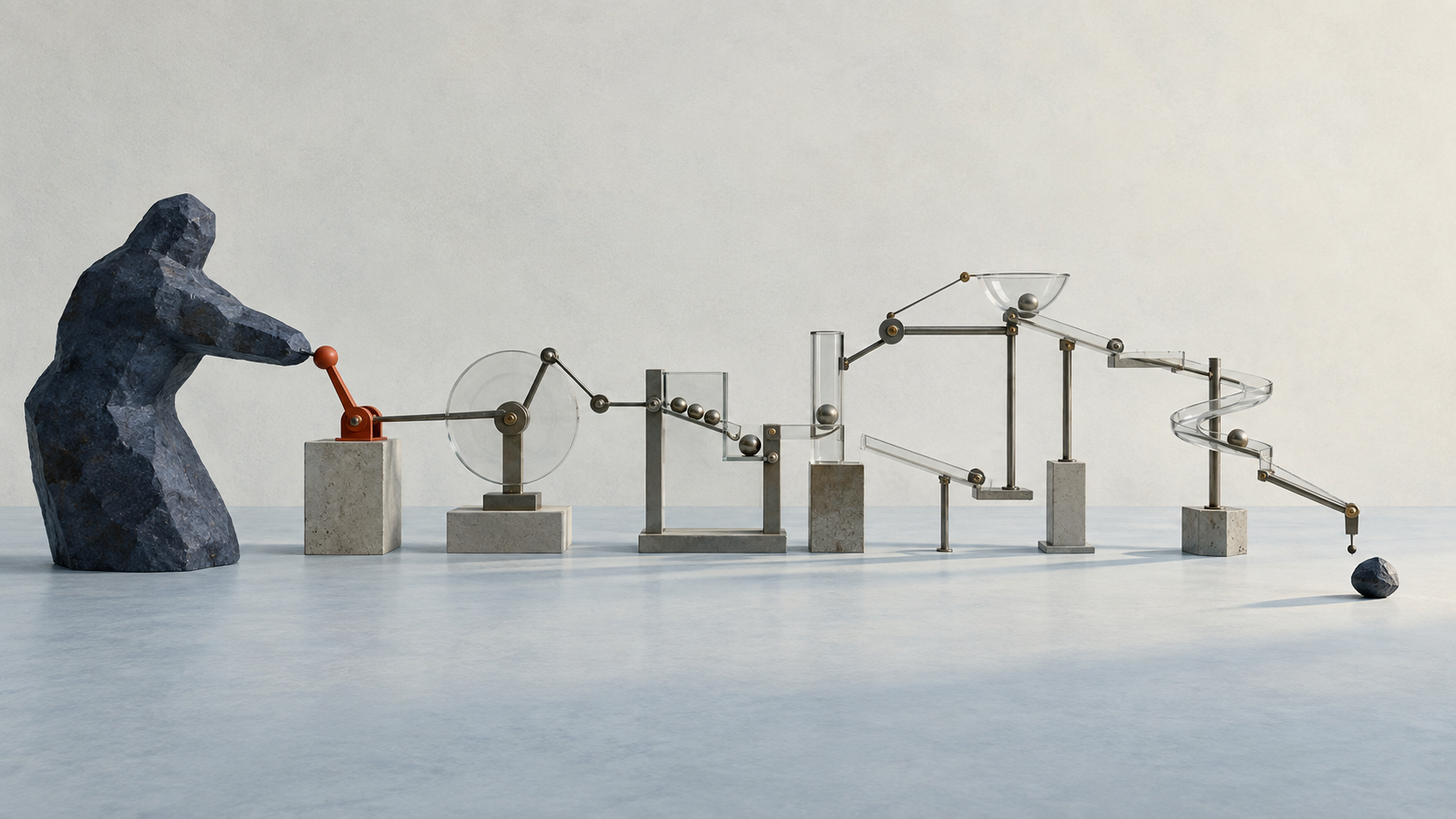
The scene begins with a visible act. An irregular form reaches a red lever. The point of contact is small, but the relationship is clear: someone begins the movement. The mechanism will travel because this figure moved it.
Older machines often kept action and effect close enough to observe. A switch opened a gate. A hand changed a setting. Responsibility could still be disputed, but the act had a place and a time.
02 / The chain
Here, the system stretches across the frame. One wheel tips a track. A metal ball releases an arm, which sends another ball through glass. Each part follows a local rule. No part can see the whole journey.
Automated decisions inside institutions can take the same form. One team prepares the data. Another sets a threshold. Someone buys the system, and someone else follows the result during a busy working day. The outcome passes through all of them without settling anywhere for long.
03 / The comfort of one step
Each contribution can feel too small to count as the decision. A developer adjusted a number. A manager approved a tool already tested elsewhere. A caseworker accepted the ranking on the screen. Everyone touched one piece, and no one experienced themselves as the author of what followed.
This is the chain's moral comfort. It turns a decision into a process, then lets the process appear blameless. Distance rearranges authorship; it does not erase the choices carried forward.
04 / Where the object lands
At the far edge of the image, a dark object reaches the ground. For the mechanism, this is an endpoint. For a person, the equivalent could be a loan refused, a school application flagged, a work shift removed, or support delayed.
The person affected meets the system where its earlier choices are hardest to recover. They receive a result without encountering anyone who feels able to change it. An appeal may travel backwards through the same machinery, past people authorised to operate their part but unable to answer for the whole.
05 / A hand that can return
Human oversight requires more than placing a person near the final screen. That person needs enough knowledge and authority to interrupt the sequence, examine how the outcome formed, and repair what happened after an error.
The work begins before the lever moves. Institutions decide which actions a system may take, which signals deserve doubt, and where a person can still refuse the machine's direction. They can keep records that make the chain visible. They can also give the person at the receiving end a clear route to someone responsible.
Useful automation will carry some decisions beyond the reach of any single hand. The chain should never extend beyond our ability to trace it, stop it, and answer for where it lands.
The distance we permit
The red lever remains visible at the beginning of the image. So does the small object at the end. Between them lies the distance an institution has chosen to create.
In the systems we depend on, who can see the whole mechanism—and who has the authority to stop it after the first movement?