Visual essay · Identity
The mirror that begins to choose
What happens when prediction stops describing us and starts becoming a path we follow?
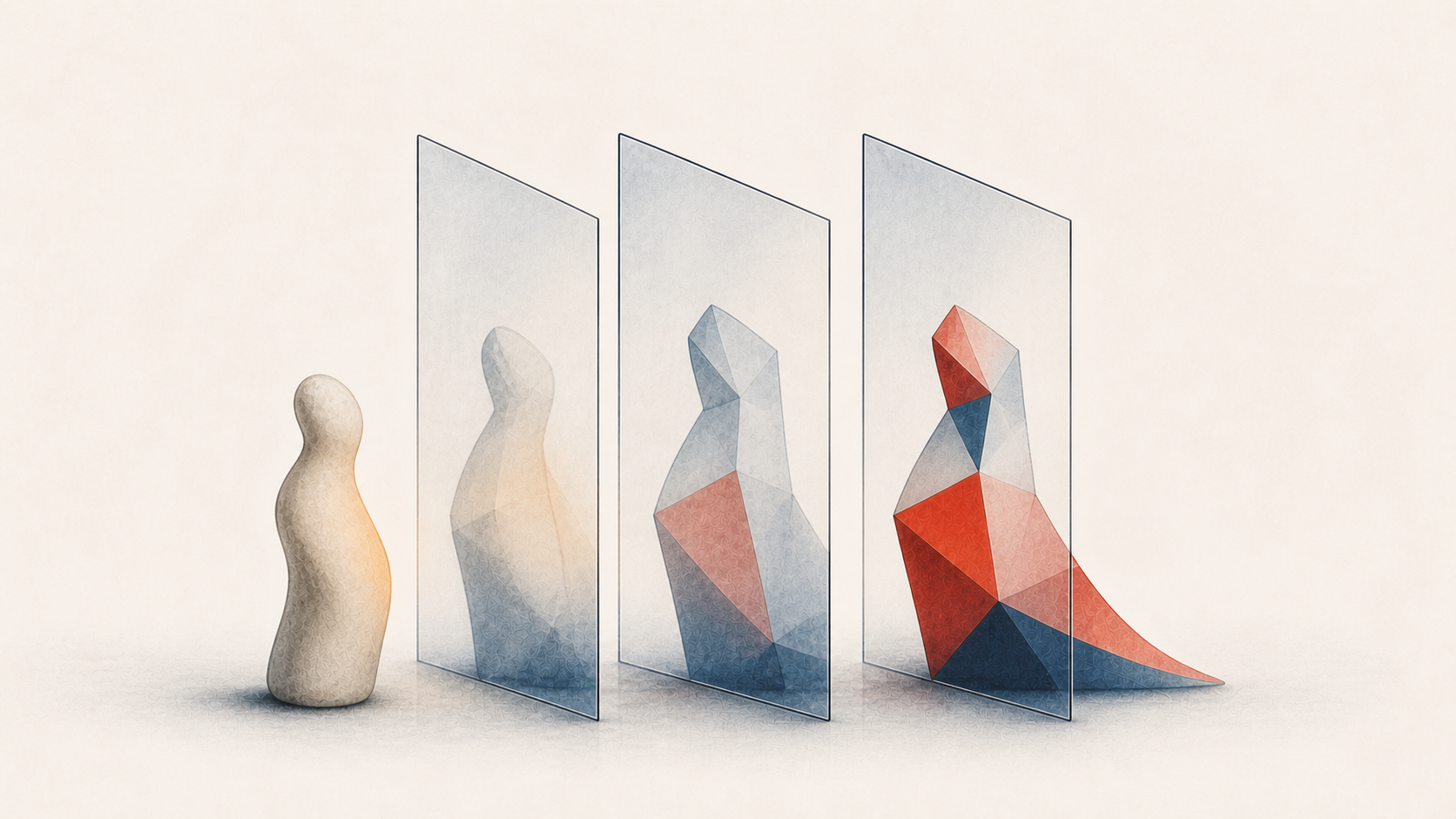
01 / Before the reflection
The first form is irregular and quiet. It has no clean category. Like a person before a question is asked, it contains more possibilities than any description can hold.
Prediction begins by reducing this openness. It needs signals: what was clicked, purchased, watched, avoided, repeated. From these traces it builds a calculable shape and presents it as a reflection.
02 / The first mirror
The first plane returns a recognisable silhouette. Its intimacy comes from recognition. The recommended song fits the mood. The completed sentence sounds like something we might have written. The system appears to have found us.
But a mirror formed from behaviour sees most clearly what has already happened. It may recognise a pattern while overlooking the desire to break it.
03 / The image hardens
Across the next plane, the reflection becomes cleaner and more geometric. Uncertainty turns into category. A temporary curiosity becomes a preference; a difficult week becomes a risk score; an old habit becomes the most likely next action.
Institutions value this hardening because decisions require boundaries. People are harder to process than profiles.
04 / The prediction returns
The final image does not remain behind the glass. It returns as an ordered feed, a suggested route, a price, an opportunity shown or withheld. The forecast changes the environment in which the person acts.
This creates a loop: behaviour produces prediction; prediction arranges choices; arranged choices produce behaviour that confirms the prediction. The mirror begins to participate in the face it claims only to reflect.
05 / The freedom to become surprising
Prediction can reduce noise, reveal danger, and make tools more humane. It becomes restrictive when the predicted self is easier to inhabit than every alternative.
A system designed for human freedom would leave room for discontinuity. It would allow interests to expire, identities to remain plural, and people to step outside the path their history makes probable.
We need not demand a world without mirrors. We should demand mirrors that remember they are partial—and doors that remain visible beside them.
A question to carry
Which version of you is being reinforced by the systems around you, and what part of you never produces enough data to be seen?